Data Analysis and Visualization for Mixed-method Social Research using R, SPSS, NVivo, and Power BI
Data Analysis and Visualization for Mixed-method Social Research using R, SPSS, NVivo, and Power BI
Urban and Rural Planning Discipline Khulna University Intermediate Level Skills Training on Data Analysis and Visualization for Mixed-method Social Research using R, SPSS, NVivo, and Power BI Two Batches: Batch 7 & Batch 8 (20 Instructional Sessions for Each Batch) Schedule: April 16, 2026 - May 20, 2026 Batch 7: Friday & Saturday 9:30 AM – 12:30 PM; Sunday, Tuesday, & Thursday 4:00 PM – 7:00 PM. Batch 8: Friday & Saturday 3:00 PM – 6:00 PM; Monday, Wednesday, & Thursday 4:00 PM – 7:00 PM. Orientation: April 16, 2026 4:00 PM Final Evaluation: May 20, 2026 4:00 PM Session Outline and Schedule Session Batch 7 Batch 8 Session Focus Resource Person S1 Apr 17 (Fri) 9:30 AM Apr 17 (Fri) 3:00 PM Research Introductions & Mixed Methods Applications Dr. Md. Nurunnabi S2 Apr 18 (Sat) 9:30 AM Apr 18 (Sat) 3:00 PM Research Questions & Design Essentials Dr. M. Shariful Islam S3 Apr 19 (Sun) 4:00 PM Apr 20 (Mon) 4:00 PM Qualitative Theory & Paradigms Dr. Md. Zakir Hossain S4 Apr 21 (Tue) 4:00 PM Apr 22 (Wed) 4:00 PM NVivo Interface & Software Setup Md. Mostafizur Rahman S5 Apr 23 (Thu) 4:00 PM Apr 26 (Sun) 4:00 PM Importing & Organizing Qualitative Data Md. Mostafizur Rahman S6 Apr 24 (Fri) 9:30 AM Apr 24 (Fri) 3:00 PM Coding Techniques & Thematic Development Md. Mostafizur Rahman Mid-Term Apr 25 (Sat) 9:30 AM Apr 25 (Sat) 3:00 PM Practical Lab Task (Evaluation) Panel / Faculty S7 Apr 27 (Mon) 4:00 PM Apr 28 (Tue) 4:00 PM Advanced Mixed Method Logic & Projects Dr. Md. Nurunnabi S8 Apr 29 (Wed) 4:00 PM Apr 30 (Thu) 4:00 PM Power BI: Data Connection & ETL Md. Rejaur Rahman S9 May 01 (Fri) 9:30 AM May 01 (Fri) 3:00 PM Power BI: Dashboarding & Project Reporting Md. Rejaur Rahman S10 May 02 (Sat) 9:30 AM May 02 (Sat) 3:00 PM Intro to SPSS & Dataset Management Dr. Md. Salauddin S11 May 03 (Sun) 4:00 PM May 04 (Mon) 4:00 PM Quantitative Data Cleaning & Prep Dr. Md. Salauddin S12 May 05 (Tue) 4:00 PM May 06 (Wed) 4:00 PM Descriptive Stats & Cross-tabulation Dr. Kazi Saiful Islam S13 May 07 (Thu) 4:00 PM May 10 (Sun) 4:00 PM Correlation & Regression Analysis Dr. Kazi Saiful Islam S14 May 08 (Fri) 9:30 AM May 08 (Fri) 3:00 PM Factor Analysis & Reliability Testing Dr. Kazi Saiful Islam S15 May 09 (Sat) 9:30 AM May 09 (Sat) 3:00 PM Intro to R & Mixed Method Data Wrangling Dr. M. Shariful Islam S16 May 11 (Mon) 4:00 PM May 12 (Tue) 4:00 PM R for Text Analysis & Visualization Dr. M. Shariful Islam S17 May 13 (Wed) 4:00 PM May 14 (Thu) 4:00 PM Structural Equation Modeling (SEM) Dr. Md. Nurunnabi S18 May 15 (Fri) 9:30 AM May 15 (Fri) 3:00 PM R: Integrated Mixed Method Synthesis Dr. M. Shariful Islam S19 May 16 (Sat) 9:30 AM May 16 (Sat) 3:00 PM Final Project Consultation & Refinement Dr. M. Shariful Islam S20 May 17 (Sun) 4:00 PM May 18 (Mon) 4:00 PM Project Presentations & Defense Dr. M. Shariful Islam Final Exam May 20 (Wed) 4:00 PM May 20 (Wed) 4:00 PM Overall Assessment of the Training Panel/Faculty Intermediate Level Skills Training on Data Analysis and Visualization for Mixed-method Social Research using R, SPSS, NVivo, and Power BI Overall Goal of the Program The primary objective is to equip participants with a multidisciplinary toolkit to design, execute, and communicate high-level social and technical research. By the end of this training, trainees will be able to move beyond simple spreadsheets to create a unified narrative that validates qualitative human experiences with quantitative statistical evidence. The program aims to foster Data Fluency, where students can switch between the "How & Why" (Qualitative) and the "How Much" (Quantitative) to provide holistic solutions in Urban/Rural Planning, Business Development, and Scientific Research. ________________________________________ Course Learning Outcomes (CLOs) By the end of this 20-session training, participants will be able to: 1. Methodological Design ● Design a mixed-method research framework (Exploratory, Explanatory, or Convergent) that addresses complex problems in their respective fields (Business, Biotech, etc.). ● Formulate integrated research questions that bridge the gap between human sentiment and numerical data. 2. Qualitative Mastery (NVivo) ● Systematize unstructured data (interviews, reports, PDFs) into a rigorous thematic hierarchy using NVivo. ● Evaluate qualitative patterns through advanced queries and thematic maps to extract deep "human-centric" insights. 3. Data Engineering & BI (Power BI) ● Execute ETL (Extract, Transform, Load) processes to clean and "wrangle" messy real-world datasets. ● Construct interactive, multi-layered dashboards that allow stakeholders to visualize cross-disciplinary trends. 4. Statistical Validation (SPSS) ● Perform advanced statistical tests—including Multiple Regression, Factor Analysis, and Reliability Testing—to validate research hypotheses. ● Interpret statistical significance to ensure that findings are scientifically robust and not coincidental. 5. Computational Synthesis (R) ● Automate data cleaning and text mining tasks using R programming for reproducibility. ● Generate high-resolution, publication-quality visualizations and perform Structural Equation Modeling (SEM) to map complex cause-and-effect chains. 6. Communication & Defense ● Synthesize conflicting or complementary data into a single, cohesive "Meta-Inference." ● Present and Defend an integrated research project before a technical panel, demonstrating both technical skill and logical clarity. Module 1: Research Foundations & Qualitative Logic Focus: Setting the stage for mixed-method inquiry across diverse disciplines. ● S1: Research Introductions & Mixed Methods Applications ○ Resource Person: Dr. Md. Nurunnabi ● S2: Research Questions & Design Essentials ○ Resource Person: Dr. M. Shariful Islam ● S3: Qualitative Theory & Paradigms ○ Resource Person: Dr. Md. Zakir Hossain Module 2: Qualitative Analytics with NVivo Focus: Managing non-numeric data, transcripts, and thematic discovery. ● S4: NVivo Interface & Software Setup ○ Resource Person: Md. Mostafizur Rahman ● S5: Importing & Organizing Qualitative Data ○ Resource Person: Md. Mostafizur Rahman ● S6: Coding Techniques & Thematic Development ○ Resource Person: Md. Mostafizur Rahman ● Mid-Term: Practical Lab Task (Qualitative Evaluation) ○ Panel / Faculty Module 3: Project Logic & Business Intelligence Focus: Visualizing data flows and connecting disparate datasets. ● S7: Advanced Mixed Method Logic & Projects ○ Resource Person: Dr. Md. Nurunnabi ● S8: Power BI: Data Connection & ETL (Extract, Transform, Load) ○ Resource Person: Md. Rejaur Rahman ● S9: Power BI: Dashboarding & Project Reporting ○ Resource Person: Md. Rejaur Rahman Module 4: Quantitative Rigor with SPSS Focus: Statistical validation and hypothesis testing. ● S10: Intro to SPSS & Dataset Management ○ Resource Person: Dr. Md. Salauddin ● S11: Quantitative Data Cleaning & Preparation ○ Resource Person: Dr. Md. Salauddin ● S12: Descriptive Stats & Cross-tabulation ○ Resource Person: Dr. Kazi Saiful Islam ● S13: Correlation & Regression Analysis ○ Resource Person: Dr. Kazi Saiful Islam ● S14: Factor Analysis & Reliability Testing ○ Resource Person: Dr. Kazi Saiful Islam Module 5: The Computational Bridge with R Focus: Using R as a synthesis tool for text analysis and data visualization. ● S15: Intro to R & Mixed Method Data Wrangling ○ Resource Person: Dr. M. Shariful Islam ● S16: R for Text Analysis & Visualization ○ Resource Person: Dr. M. Shariful Islam ● S17: Structural Equation Modeling (SEM) ○ Resource Person: Dr. Md. Nurunnabi Module 6: Integrated Synthesis & Presentation Focus: Merging findings into a single, cohesive research narrative. ● S18: R: Integrated Mixed Method Synthesis ○ Resource Person: Dr. M. Shariful Islam ● S19: Final Project Consultation & Refinement ○ Resource Person: Dr. M. Shariful Islam ● S20: Project Presentations & Defense ○ Resource Person: Dr. M. Shariful Islam ● Final Exam: Overall Assessment of the Training ○ Panel / Faculty Module 1: Research Foundations & Qualitative Logic Focus: Setting the stage for mixed-method inquiry across diverse disciplines. S1: Research Introductions & Mixed Methods Applications ○ Resource Person: Dr. Md. Nurunnabi Goal: To move beyond the "Quant vs. Qual" debate and understand why integrated research is the gold standard for modern social and scientific inquiry. ● The Philosophy of Pragmatism: Understanding that the research question should dictate the method, not the other way around. ● The "Why" of Mixed Methods (MM): * Triangulation: Using different data sources to validate a single finding. ○ Complementarity: Using one method to clarify or illustrate results from another. ● Case Studies across Disciplines: ○ Business: Combining quarterly sales data (Quant) with focus group insights on brand loyalty (Qual). ○ Biotechnology: Analyzing the adoption rate of a new bio-fertilizer (Quant) alongside interviews with farmers regarding cultural barriers to its use (Qual). ● Core MM Designs: Brief introduction to Convergent, Explanatory Sequential, and Exploratory Sequential designs. S2: Research Questions & Design Essentials ○ Resource Person: Dr. M. Shariful Islam Goal: To transform a broad interest into a specific, executable research plan that can be completed within the training timeframe. ● Drafting "Mixed" Questions: Learning to write questions that address both breadth (How many? To what extent?) and depth (Why? How does it feel?). ● The Research Blueprint: Selecting a "Core" method (e.g., is your study primarily a survey supported by interviews, or an interview study supported by stats?). ● Variable Identification: * Independent vs. Dependent variables for the Quant side. ○ Unit of Analysis for the Qual side. ● Feasibility and Scoping: How to narrow down a project so it can be realistically analyzed using the four software tools (NVivo, Power BI, SPSS, R). S3: Qualitative Theory & Paradigms ○ Resource Person: Dr. Md. Zakir Hossain Goal: To provide the theoretical "Backbone" for the upcoming NVivo sessions, ensuring students understand that qualitative research is a systematic science, not just "talking to people." ● The Researcher as the Instrument: Understanding how a researcher's background (Business vs. Science) influences their interpretation of text. ● Major Qualitative Paradigms: ○ Phenomenology: Studying the "lived experience" (useful for patient journeys in Biotech or employee experiences in Business). ○ Grounded Theory: Building a new theory directly from the data. ○ Case Study Research: Analyzing a specific organization or ecosystem in depth. ● Ensuring "Trustworthiness": Concepts of Credibility, Transferability, Dependability, and Confirmability (the qualitative equivalent of Validity and Reliability). ● Sampling Logic: Moving from "Statistical Representativeness" to "Information Richness" (Purposive and Snowball sampling). Module 2: Qualitative Analytics with NVivo Focus: Managing non-numeric data, transcripts, and thematic discovery. S4: NVivo Interface & Software Setup ○ Resource Person: Md. Mostafizur Rahman Goal: To familiarize students with the NVivo environment and prepare their workspace for multi-disciplinary data. ● Workspace Optimization: Navigating the Ribbon, Navigation Pane, and Detail View. ● Project Initialization: Creating a new project and setting up "Folders" for different data types (e.g., Interviews, Focus Groups, Literature Reviews). ● Case Classifications: Setting up "Attributes" (e.g., Age, Gender, Department, Profession). ○ Example: A Biotech student might classify sources by "Lab Type," while a Business student classifies by "Company Size." ● Concept of "Nodes": Introduction to the "Container" logic—where snippets of text will be stored during analysis. S5: Importing & Organizing Qualitative Data ○ Resource Person: Md. Mostafizur Rahman Goal: To bring raw data into the system and ensure it is organized for efficient retrieval. ● Data Diversity: Importing Word documents (Transcripts), PDFs (Research papers/Company reports), and Audio/Video files. ● External vs. Internal Data: Managing large files through file linking without slowing down the software. ● Transcription Integration: How to use auto-transcription or manually sync audio to text. ● Memos and Annotations: Using "Internal Memos" to record the researcher's thoughts and "Annotations" for specific text highlights—crucial for maintaining a "Research Audit Trail." S6: Coding Techniques & Thematic Development ○ Resource Person: Md. Mostafizur Rahman Goal: The heart of qualitative analysis—turning raw text into meaningful "Themes." ● Manual Coding: * First Cycle: Open Coding (What is happening here?). ○ Second Cycle: Axial Coding (How do these codes relate?). ● Thematic Hierarchy: Creating "Parent" and "Child" nodes to build a logical structure (e.g., Parent: Barriers to Adoption; Children: Cost, Lack of Training, Technical Complexity). ● Query Tools: Using "Word Frequency" and "Text Search" queries to find patterns across 50+ documents instantly. ● Visualization: Creating "Code Clouds" and "Hierarchy Maps" to represent the weight of different themes visually. Mid-Term: Practical Lab Task (Qualitative Evaluation) ○ Panel / Faculty Goal: To assess whether students can independently move from raw data to a preliminary thematic map. ● The Task: Students will be given a small set of raw transcripts (related to a general social issue). ● Requirements: 1. Properly set up a project. 2. Import and classify the data. 3. Create at least 5 meaningful nodes. 4. Generate a "Comparison Diagram" or "Hierarchy Map." ● Grading Criteria: Logic of coding, organization of the NVivo workspace, and ability to explain the developed themes. Module 3: Project Logic & Business Intelligence Focus: Visualizing data flows and connecting disparate datasets. S7: Advanced Mixed Method Logic & Projects ○ Resource Person: Dr. Md. Nurunnabi Goal: To move from software-specific tasks to the "Big Picture" architecture of a Mixed Methods project. ● The Point of Interface (POI): Determining exactly where the qualitative and quantitative data will merge (e.g., using qualitative themes to create quantitative survey scales). ● Developing a Logic Framework: * Mapping Inputs (Data sources) $\rightarrow$ Activities (Analysis) $\rightarrow$ Outputs (Visualizations) $\rightarrow$ Outcomes (Policy/Business recommendations). ● Joint Display Planning: Designing how to present mixed data side-by-side in a final report (e.g., a table that pairs a statistical trend with a supporting participant quote). ● Case Specifics: * Business: Validating a "Market Success" model. ○ Biotech: Validating "Lab Efficacy" with "User Adoption" logic. S8: Power BI: Data Connection & ETL (Extract, Transform, Load) ○ Resource Person: Md. Rejaur Rahman Goal: To master the "Data Cleaning" phase using Power Query—essential for students handling messy real-world datasets. ● Data Sourcing: Connecting Power BI to multiple formats (Excel, CSV, Web, and even Folder-level imports). ● The Power Query Editor: * Cleaning: Removing nulls, splitting columns (e.g., Names into First/Last), and fixing data types. ○ Transformation: "Unpivoting" columns to make data readable for analysis. ● The Data Model: Creating "Relationships" (One-to-Many) between different tables (e.g., linking a "Sales Table" to a "Product Category Table" or "Lab Results" to "Patient ID"). S9: Power BI: Dashboarding & Project Reporting ○ Resource Person: Md. Rejaur Rahman Goal: To transform raw data into an interactive, visual narrative that stakeholders can explore. ● DAX Basics (Intro): Creating simple "Measures" like Total Sales, Average Growth, or Success Rate. ● Visual Selection: Choosing the right chart for the right data (e.g., Treemaps for Categories, Line charts for Trends, and Map visuals for Geographic data). ● Interactivity Features: * Slicers: Allowing users to filter the entire dashboard by "Department," "Batch," or "Region." ○ Tooltips: Showing detailed "Qualitative Summaries" when hovering over a quantitative data point. ● Design for Impact: Best practices in "Data Storytelling"—arranging visuals to lead the viewer to a conclusion. Module 4: Quantitative Rigor with SPSS Focus: Statistical validation and hypothesis testing. S10: Intro to SPSS & Dataset Management ○ Resource Person: Dr. Md. Salauddin Goal: To master the SPSS environment and the fundamental architecture of a quantitative dataset. ● Variable View vs. Data View: Setting up the "Variable Properties" (Name, Type, Width, Decimals, Label, Values, and Missing). ● Measurement Levels: Understanding the difference between Nominal (e.g., Business Sector), Ordinal (e.g., Satisfaction Level), and Scale (e.g., Lab Temperature or Annual Revenue). ● Data Entry & Import: Best practices for importing data from Excel while maintaining data integrity. ● Data Auditing: Using "Sort Cases" and "Identify Duplicate Cases" to ensure the dataset is ready for analysis. S11: Quantitative Data Cleaning & Preparation ○ Resource Person: Dr. Md. Salauddin Goal: To perform "Data Surgery"—fixing errors and creating new metrics for analysis. ● Handling Missing Values: Deciding whether to exclude cases or use mean imputation. ● Data Transformation: * Recode into Different Variables: Turning continuous data (e.g., Age) into categorical brackets (e.g., 18–25, 26–35). ○ Compute Variable: Creating a "Total Performance Score" by summing multiple survey questions. ● Visual Binning: Automatically grouping data based on distribution. S12: Descriptive Stats & Cross-tabulation ○ Resource Person: Dr. Kazi Saiful Islam Goal: To summarize the dataset and explore the relationships between different groups. ● Frequencies & Descriptives: Generating Mean, Median, Mode, Standard Deviation, and Skewness. ● Cross-tabulation: Creating "Pivot Tables" to compare two categorical variables (e.g., "Success Rate" vs. "Management Style"). ● The Chi-Square Test: Determining if the relationship found in a cross-tab is statistically significant or merely coincidental. ● Standardizing Outputs: Exporting SPSS tables into a format suitable for professional reports. S13: Correlation & Regression Analysis ○ Resource Person: Dr. Kazi Saiful Islam Goal: To move from "Describing" to "Predicting" outcomes. ● Bivariate Correlation: Using Pearson’s r (for scale data) and Spearman’s rho (for ordinal data) to measure the strength and direction of a relationship. ● Simple Linear Regression: Predicting a dependent variable (e.g., Crop Yield) based on one independent variable (e.g., Fertilizer Amount). ● Multiple Regression: Analyzing how multiple factors simultaneously influence an outcome (e.g., How "Location," "Price," and "Advertising" affect "Sales Volume"). S14: Factor Analysis & Reliability Testing ○ Resource Person: Dr. Kazi Saiful Islam Goal: To validate complex measurement scales—critical for students using surveys or psychometric tools. ● Cronbach’s Alpha ($\alpha$): Testing the "Internal Consistency" of a scale. (Is your 10-question survey actually measuring one single concept?). ● Exploratory Factor Analysis (EFA): Reducing a large number of variables into a few "Factors" to simplify the model. ● KMO and Bartlett’s Test: Statistical checks to see if the data is suitable for factor analysis. ● Interpreting the Rotated Component Matrix: Identifying which items "load" onto which factors. Module 5: The Computational Bridge with R Focus: Using R as a synthesis tool for text analysis and data visualization. S15: Intro to R & Mixed Method Data Wrangling ○ Resource Person: Dr. M. Shariful Islam Goal: To demystify coding and learn how to use R as a powerful data cleaning and organization engine. ● RStudio Ecosystem: Understanding the Script Editor, Console, Environment, and Plots panes. ● The Tidyverse Philosophy: Installing and loading essential packages (like dplyr and tidyr). ● Wrangling Multidisciplinary Data: * Filtering & Selecting: Isolating specific business sectors or lab test batches. ○ Mutating: Creating new variables through code (e.g., calculating ROI or growth rates). ● Joining Datasets: Merging a quantitative "Survey" file with a "Qualitative Metadata" file using common IDs. S16: R for Text Analysis & Visualization ○ Resource Person: Dr. M. Shariful Islam Goal: To apply computational power to the "words" gathered in earlier sessions, automating text patterns that are too large for manual coding. ● Text Mining (Tidytext): Breaking down interview transcripts or company reports into "tokens" (individual words). ● Sentiment Analysis: Assigning "Emotional Scores" to text (e.g., Are consumer reviews or patient feedback generally Positive, Negative, or Neutral?). ● Data Visualization with ggplot2: * Creating high-resolution bar charts and scatter plots for Business reports. ○ Generating Word Clouds and Bigram Networks (showing which words frequently appear together). ● The Custom Edge: Learning to customize colors, themes, and labels for publication-quality graphics. S17: Structural Equation Modeling (SEM) ○ Resource Person: Dr. Md. Nurunnabi Goal: To perform advanced statistical modeling that explains complex, multi-layered relationships. ● Beyond Regression: Understanding how "Latent Variables" (concepts you can't measure directly, like Brand Loyalty or Ecosystem Health) are analyzed. ● Path Analysis: Visualizing how one variable affects another through an intermediate step (Mediation). ● Model Fit Indices: Learning to read CFI, TLI, and RMSEA to see if your proposed research model actually matches the real-world data. ● Application: ○ Business: How "Leadership" affects "Employee Satisfaction," which then affects "Customer Retention." ○ Biotech: How "Environmental Factors" affect "Microbial Growth," which then affects "Yield Quality." Module 6: Integrated Synthesis & Presentation Focus: Merging findings into a single, cohesive research narrative. S18: R: Integrated Mixed Method Synthesis ○ Resource Person: Dr. M. Shariful Islam Goal: To move beyond separate analyses and perform "Crossover Analysis" using R. ● Meta-Inferences: Learning the art of combining qualitative themes and quantitative results into a single coherent conclusion. ● Joint Displays in R: Using R code to generate complex tables and charts that present mixed data side-by-side (e.g., a "Side-by-Side Comparison" plot). ● Transforming Data: Introduction to "Quantitizing" (turning qualitative themes into binary numeric data) or "Qualitizing" (creating narrative profiles from statistical clusters). ● Reporting Reproducibility: A brief look at RMarkdown to show how to generate automated reports that include text, code, and visuals. S19: Final Project Consultation & Refinement ○ Resource Person: Dr. M. Shariful Islam Goal: One-on-one and group-based troubleshooting to polish the final training project. ● Data Audit: Final check of the SPSS outputs and NVivo nodes for logic and consistency. ● Visualization Critique: Refining Power BI dashboards and R plots for clarity, accessibility, and "storytelling" impact. ● Narrative Flow: Ensuring the project doesn't look like two separate studies, but a single integrated investigation. ● Addressing the "So What?": Translating complex SEM models or text mining results into actionable Business strategies or Biotech policy recommendations. S20: Project Presentations & Defense ○ Resource Person: Dr. M. Shariful Islam Goal: To demonstrate mastery of the mixed-method workflow through a formal presentation. ● The 10-Minute Pitch: Trainees present their research problem, their mixed-method design, the integrated findings, and their final conclusion. ● Panel Q&A: Defending the choice of methods and the interpretation of the data before a faculty panel. ● Peer Feedback: Business students and Biotech students critique each other’s projects, fostering a cross-disciplinary understanding of data limitations and strengths. Final Exam: Overall Assessment of the Training ○ Panel / Faculty Goal: To certify the technical and theoretical competency of each trainee. ● The Format: A comprehensive evaluation that may include: ○ Technical Viva: Explaining a specific step in the SPSS or R pipeline. ○ Conceptual Quiz: Identifying the correct Mixed Method design for a given scenario. ○ Final Project Portfolio: Submission of the cleaned datasets, NVivo project files, and the final presentation deck. ● Certification Criteria: Successful completion of the Mid-term, all session activities, and the final project defense.
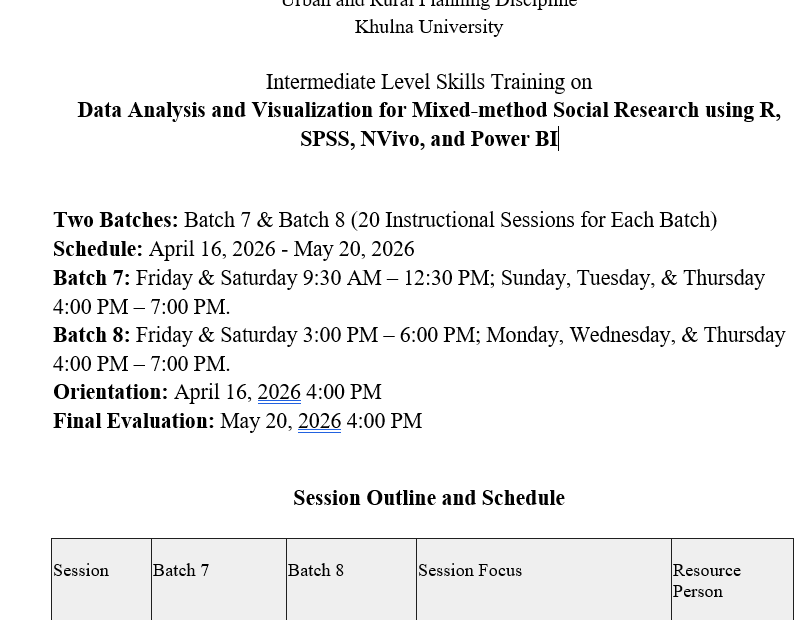
Urban and Rural Planning Discipline
Khulna University
Intermediate Level Skills Training on
Data Analysis and Visualization for Mixed-method Social Research using R, SPSS, NVivo, and Power BI
Two Batches: Batch 7 & Batch 8 (20 Instructional Sessions for Each Batch)
Schedule: April 16, 2026 - May 20, 2026
Batch 7: Friday & Saturday 9:30 AM – 12:30 PM; Sunday, Tuesday, & Thursday 4:00 PM – 7:00 PM.
Batch 8: Friday & Saturday 3:00 PM – 6:00 PM; Monday, Wednesday, & Thursday 4:00 PM – 7:00 PM.
Orientation: April 16, 2026 4:00 PM
Final Evaluation: May 20, 2026 4:00 PM
Session Outline and Schedule
|
Session |
Batch 7 |
Batch 8 |
Session Focus |
Resource Person |
|
S1 |
Apr 17 (Fri) 9:30 AM |
Apr 17 (Fri) 3:00 PM |
Research Introductions & Mixed Methods Applications |
Dr. Md. Nurunnabi |
|
S2 |
Apr 18 (Sat) 9:30 AM |
Apr 18 (Sat) 3:00 PM |
Research Questions & Design Essentials |
Dr. M. Shariful Islam |
|
S3 |
Apr 19 (Sun) 4:00 PM |
Apr 20 (Mon) 4:00 PM |
Qualitative Theory & Paradigms |
Dr. Md. Zakir Hossain |
|
S4 |
Apr 21 (Tue) 4:00 PM |
Apr 22 (Wed) 4:00 PM |
NVivo Interface & Software Setup |
Md. Mostafizur Rahman |
|
S5 |
Apr 23 (Thu) 4:00 PM |
Apr 26 (Sun) 4:00 PM |
Importing & Organizing Qualitative Data |
Md. Mostafizur Rahman |
|
S6 |
Apr 24 (Fri) 9:30 AM |
Apr 24 (Fri) 3:00 PM |
Coding Techniques & Thematic Development |
Md. Mostafizur Rahman |
|
Mid-Term |
Apr 25 (Sat) 9:30 AM |
Apr 25 (Sat) 3:00 PM |
Practical Lab Task (Evaluation) |
Panel / Faculty |
|
S7 |
Apr 27 (Mon) 4:00 PM |
Apr 28 (Tue) 4:00 PM |
Advanced Mixed Method Logic & Projects |
Dr. Md. Nurunnabi |
|
S8 |
Apr 29 (Wed) 4:00 PM |
Apr 30 (Thu) 4:00 PM |
Power BI: Data Connection & ETL |
Md. Rejaur Rahman |
|
S9 |
May 01 (Fri) 9:30 AM |
May 01 (Fri) 3:00 PM |
Power BI: Dashboarding & Project Reporting |
Md. Rejaur Rahman |
|
S10 |
May 02 (Sat) 9:30 AM |
May 02 (Sat) 3:00 PM |
Intro to SPSS & Dataset Management |
Dr. Md. Salauddin |
|
S11 |
May 03 (Sun) 4:00 PM |
May 04 (Mon) 4:00 PM |
Quantitative Data Cleaning & Prep |
Dr. Md. Salauddin |
|
S12 |
May 05 (Tue) 4:00 PM |
May 06 (Wed) 4:00 PM |
Descriptive Stats & Cross-tabulation |
Dr. Kazi Saiful Islam |
|
S13 |
May 07 (Thu) 4:00 PM |
May 10 (Sun) 4:00 PM |
Correlation & Regression Analysis |
Dr. Kazi Saiful Islam |
|
S14 |
May 08 (Fri) 9:30 AM |
May 08 (Fri) 3:00 PM |
Factor Analysis & Reliability Testing |
Dr. Kazi Saiful Islam |
|
S15 |
May 09 (Sat) 9:30 AM |
May 09 (Sat) 3:00 PM |
Intro to R & Mixed Method Data Wrangling |
Dr. M. Shariful Islam |
|
S16 |
May 11 (Mon) 4:00 PM |
May 12 (Tue) 4:00 PM |
R for Text Analysis & Visualization |
Dr. M. Shariful Islam |
|
S17 |
May 13 (Wed) 4:00 PM |
May 14 (Thu) 4:00 PM |
Structural Equation Modeling (SEM) |
Dr. Md. Nurunnabi |
|
S18 |
May 15 (Fri) 9:30 AM |
May 15 (Fri) 3:00 PM |
R: Integrated Mixed Method Synthesis |
Dr. M. Shariful Islam |
|
S19 |
May 16 (Sat) 9:30 AM |
May 16 (Sat) 3:00 PM |
Final Project Consultation & Refinement |
Dr. M. Shariful Islam |
|
S20 |
May 17 (Sun) 4:00 PM |
May 18 (Mon) 4:00 PM |
Project Presentations & Defense |
Dr. M. Shariful Islam |
|
Final Exam |
May 20 (Wed) 4:00 PM |
May 20 (Wed) 4:00 PM |
Overall Assessment of the Training |
Panel/Faculty |
Intermediate Level Skills Training on
Data Analysis and Visualization for Mixed-method Social Research using R, SPSS, NVivo, and Power BI